
What Is Déjà Vu? What Research Tells Us
Most people have experienced déjà vu, yet researchers still cannot reliably trigger an ordinary episode on demand. That has made it unusually difficult to study: it appears without warning, lasts only seconds, and leaves behind the unsettling sense that the present moment has happened before.
To investigate it, researchers have relied on three main approaches:
- Surveying people about past déjà vu episodes and looking for common patterns.
- Creating laboratory situations that can produce a similar feeling and reveal possible triggers.
- Studying people with temporal lobe epilepsy, because some experience déjà vu during a seizure, giving researchers a rare look at the brain activity involved.
The picture that emerged is reasonably clear. Déjà vu is a memory phenomenon rather than something mystical, and the leading explanation is that the brain briefly creates a false sense of familiarity despite knowing the situation is new.
Why this mismatch occurs is still uncertain, but one finding is consistent: déjà vu does not predict the future — even when it feels as if you know what is about to happen.
What is déjà vu?
The phrase déjà vu is French for “already seen.” It entered the scientific literature in 1896 and describes the sudden feeling that you have experienced the present moment before, even though you know it is new. That mismatch between familiarity and reality is what makes déjà vu feel so strange.
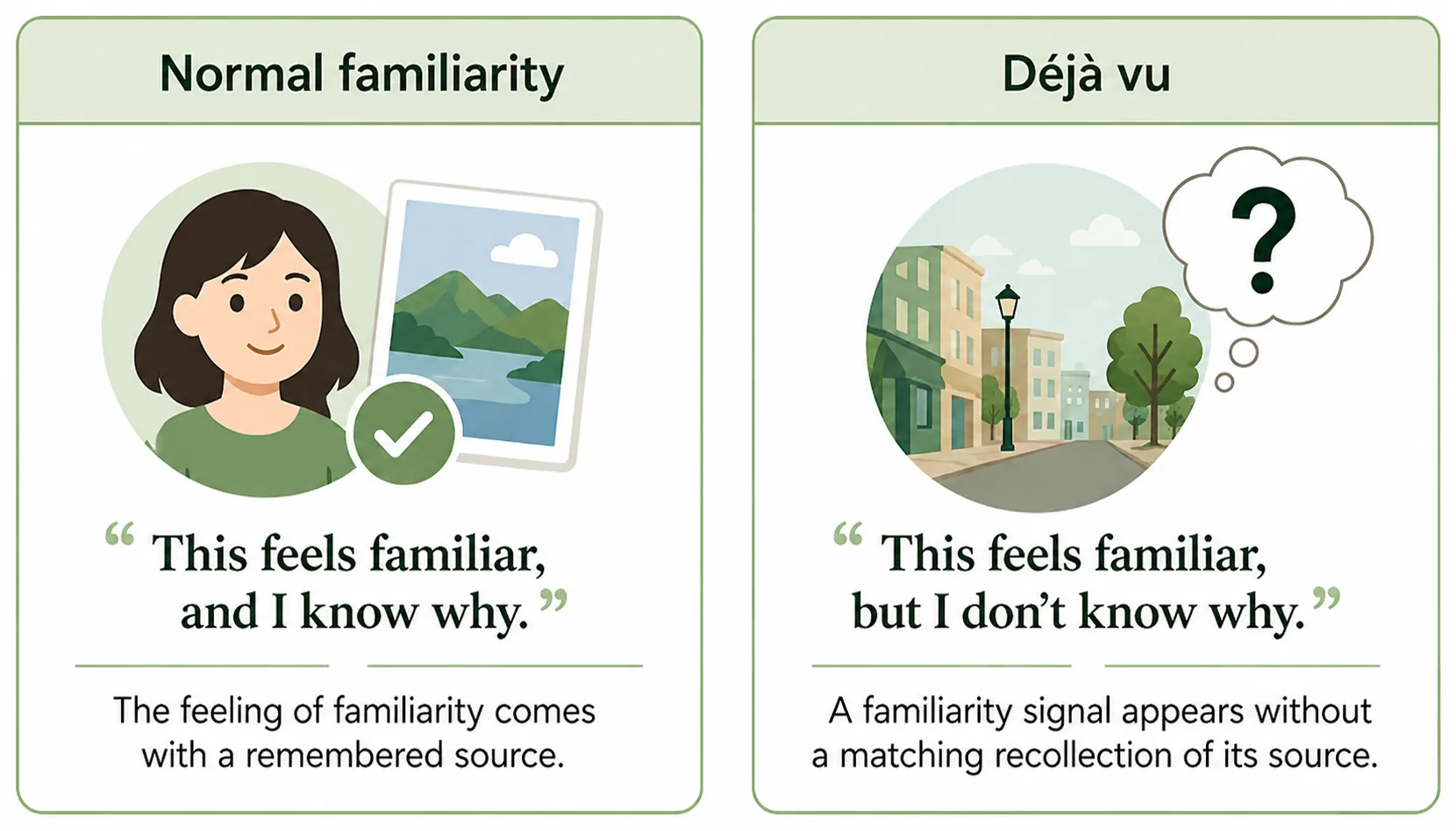
Despite how unusual it feels, déjà vu is actually very common. A 2024 systematic review estimated that about 74% of healthy people have experienced it at least once, while an earlier major review put the figure at around 60%.
For most people, episodes are brief and occasional. About two-thirds last only a few seconds, and many occur just a few times a year. Fewer than 1% report déjà vu weekly.
What causes déjà vu? The leading theories
Déjà vu follows a clear age pattern. It is most common in the late teens and twenties, then becomes less frequent with age. That argues against simple memory decline as the cause, because déjà vu becomes less common — not more — as people get older.
| Fat type | Common Examples | General effect |
| Hidden memory (memory theory) | Something new feels familiar because it resembles a past experience you cannot recall. | In virtual-reality studies, new scenes with layouts resembling earlier scenes increased familiarity and made déjà vu more likely. |
| Memory conflict (Dual-processing theory) | One part of the brain signals “familiar,” while another recognises the situation as new. | Brain imaging shows activity in regions involved in detecting conflict when déjà vu occurs. |
| Unusual brain activity (neurological theory) | Brief unusual activity in memory-related brain areas may create a false familiarity signal. | Déjà vu can occur during temporal lobe seizures, and electrical stimulation of medial temporal regions in epilepsy patients can trigger déjà-vu-like experiences. |
| Split attention (attentional theory) | A scene is processed briefly or without full attention, then noticed again moments later, making it feel familiar. | Brief exposure to unfamiliar symbols later increased false beliefs that they had been encountered before, supporting this possible mechanism. |
Overall, the strongest evidence points to two related ideas: a false sense of familiarity and the brain recognising that something does not quite match.
The significance of déjà vu: does it mean anything?
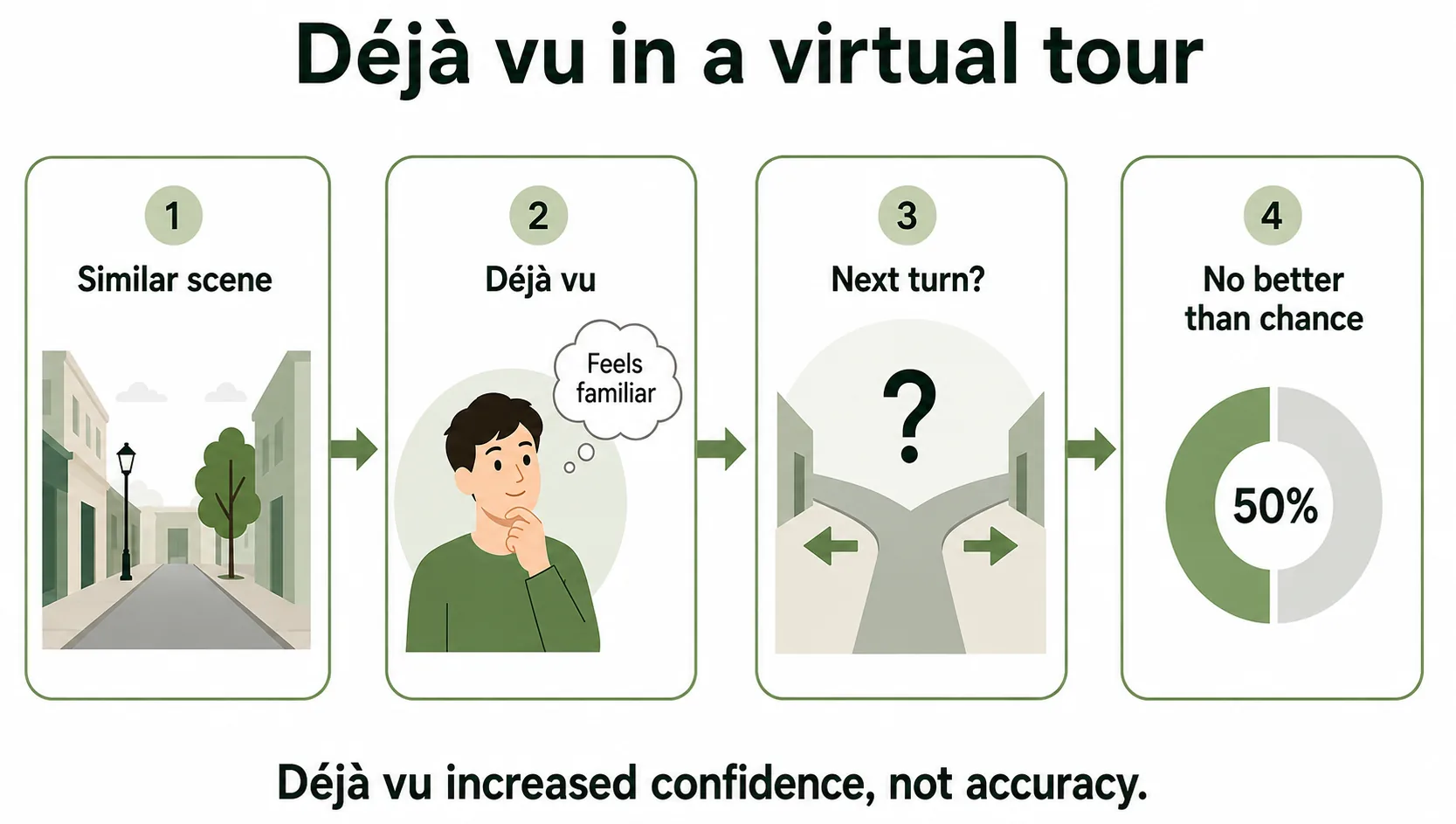
A common non-scientific interpretation is that déjà vu is precognition, or a glimpse of the future. The feeling can be very convincing, but studies suggest it does not translate into real prediction.
Cleary and Alexander Claxton tested this using virtual tours, with some scenes designed to resemble ones participants had seen earlier. When participants reported déjà vu, they felt more confident about predicting which way the path would turn next — but their guesses were no better than chance.
Other interpretations, such as déjà vu arising from a forgotten dream, also remain unproven. False-memory research shows how easily people can recall vivid events that never occurred, so a dream that feels familiar does not prove a direct connection.
So the significance of déjà vu is real but modest. It offers a useful window into how familiarity and memory monitoring interact, and it is one of the rare cognitive glitches a person can notice while it is happening. For most healthy people, occasional episodes are harmless and do not predict the future.
Jamais vu, déjà rêvé, and the rest of the family
Déjà vu belongs to a larger family of unusual familiarity and memory experiences, each with slightly different features.
Jamais vu, meaning “never seen,” is often described as the opposite of déjà vu: something you know to be familiar suddenly feels strange. Repetition can produce this effect surprisingly easily in the laboratory:
- In one study, 66 of 93 participants stopped while repeatedly writing the same word because it began to feel wrong.
- In another experiment using only the word “the,” 55% reported the same effect.
Repeating a familiar word can temporarily make it lose its normal sense of meaning, an effect known as semantic satiation.
Déjà rêvé, or “already dreamed,” is the feeling that a current situation was dreamed beforehand. In one large online survey, nearly 80% of respondents reported some form of it, although the sample was not representative of the general population. The experience has also been produced through electrical brain stimulation, but at different sites from those that triggered déjà vu. This suggests the two experiences are related, but not the same.
Déjà vécu, meaning “already lived,” goes beyond a vague sense of familiarity: a person may feel as if they actually remember living through the current situation before. Persistent cases can become delusion-like and have been reported in people with dementia and other neurological disorders.
Presque vu, meaning “almost seen,” is the feeling that a word, memory, or insight is just about to come to mind — similar to a tip-of-the-tongue state.
Frequently asked questions
Is déjà vu real?
Yes. The experience is well documented and common in healthy people. Researchers can produce laboratory analogues of it, and direct brain stimulation in epilepsy patients can trigger déjà-vu-like experiences. What is unreliable is the impression that the present event truly happened before.
What does déjà vu mean?
It means that a current experience feels familiar even though you know it should be new. The best-supported explanations involve a familiarity signal and the brain systems that check whether that signal matches reality.
What is the opposite of déjà vu?
Jamais vu — the feeling that something genuinely familiar has suddenly become strange. Déjà rêvé, déjà vécu, and presque vu are related experiences, but they are not opposites.
Which brain areas are responsible for déjà vu?
The strongest direct evidence points to the medial temporal lobe, particularly rhinal and entorhinal regions, where electrical stimulation in epilepsy patients can trigger déjà-vu-like experiences. Other memory-related and conflict-monitoring regions also appear to be involved.
When should déjà vu be checked by a doctor?
Brief, occasional déjà vu is common. Medical advice is more appropriate if episodes become new, very frequent, prolonged, or occur with symptoms such as loss of awareness, sudden intense fear, unusual smells or tastes, or repetitive movements, which can occur with some focal seizures.
The verdict
So, what is déjà vu?
Déjà vu is common, brief, and most frequent in young adults. It is best understood as a memory and familiarity phenomenon: something produces a strong sense of familiarity while the brain also recognises that the feeling does not fit the present situation.
Not every episode may have the same cause, and there is still no objective behavioural marker that proves someone has just experienced déjà vu, so much of the research relies on self-report.
What is clearer is that déjà vu does not predict the future. It can create a strong sense of knowing what comes next, but experiments show that predictions are no better than chance. The feeling may be compelling precisely because the brain is detecting familiarity while simultaneously recognising that the familiarity does not quite fit.
This article provides general research and clinical information, not individual medical advice. Anyone concerned about frequent or unusual déjà vu episodes should speak to a doctor.
References
- Brown AS. A review of the déjà vu experience. Psychological Bulletin. 2003;129(3):394–413. doi:10.1037/0033-2909.129.3.394. https://pubmed.ncbi.nlm.nih.gov/12784936/
- Hadzic A, Andersson S. Non-ictal, interictal and ictal déjà vu: a systematic review and meta-analysis. Frontiers in Neurology. 2024;15:1406889. doi:10.3389/fneur.2024.1406889. https://www.frontiersin.org/journals/neurology/articles/10.3389/fneur.2024.1406889/full
- Wild E. Déjà vu in neurology. Journal of Neurology. 2005;252(1):1–7. doi:10.1007/s00415-005-0677-3. https://discovery.ucl.ac.uk/52584/1/Wild_1447197_UCL%20deja%20vu%20Wild.pdf
- Mumoli L, Tripepi G, Aguglia U, et al. Validation study of the Italian version of the Inventory for Déjà Vu Experiences Assessment (I-IDEA). Behavioral Sciences. 2017;7(3):50. doi:10.3390/bs7030050. https://www.mdpi.com/2076-328X/7/3/50
- Cleary AM, Brown AS, Sawyer BD, Nomi JS, Ajoku AC, Ryals AJ. Familiarity from the configuration of objects in 3-dimensional space and its relation to déjà vu: a virtual reality investigation. Consciousness and Cognition. 2012;21(2):969–975. doi:10.1016/j.concog.2011.12.010. https://pubmed.ncbi.nlm.nih.gov/22322010/
- O’Connor AR, Moulin CJA. Déjà vu experiences in healthy subjects are unrelated to laboratory tests of recollection and familiarity for word stimuli. Frontiers in Psychology. 2013;4:881. doi:10.3389/fpsyg.2013.00881. https://www.frontiersin.org/journals/psychology/articles/10.3389/fpsyg.2013.00881/full
- Urquhart JA, Sivakumaran MH, Macfarlane JA, O’Connor AR. fMRI evidence supporting the role of memory conflict in the déjà vu experience. Memory. 2021;29(7):921–932. doi:10.1080/09658211.2018.1524496. https://pubmed.ncbi.nlm.nih.gov/30232927/
- Aitken CBA, Jentzsch I, O’Connor AR. Towards a conflict account of déjà vu: the role of memory errors and memory expectation conflict in the experience of déjà vu. Neuroscience & Biobehavioral Reviews. 2023;155:105467. doi:10.1016/j.neubiorev.2023.105467. https://research-repository.st-andrews.ac.uk/handle/10023/28791
- Brown AS, Marsh EJ. Digging into déjà vu: recent research on possible mechanisms. Psychology of Learning and Motivation. 2010;53:33–62. doi:10.1016/S0079-7421(10)53002-0
- Brown AS, Marsh EJ. Creating illusions of past encounter through brief exposure. Psychological Science. 2009;20(5):534–538. doi:10.1111/j.1467-9280.2009.02337.x
- O’Connor AR, Moulin CJA. Normal patterns of déjà experience in a healthy, blind male: challenging optical pathway delay theory. Brain and Cognition. 2006;62(3):246–249. doi:10.1016/j.bandc.2006.06.004. https://research-repository.st-andrews.ac.uk/handle/10023/1650
- Bancaud J, Brunet-Bourgin F, Chauvel P, Halgren E. Anatomical origin of déjà vu and vivid “memories” in human temporal lobe epilepsy. Brain. 1994;117(Pt 1):71–90. doi:10.1093/brain/117.1.71. https://academic.oup.com/brain/article/117/1/71/261622
- Bartolomei F, Barbeau E, Gavaret M, et al. Cortical stimulation study of the role of rhinal cortex in déjà vu and reminiscence of memories. Neurology. 2004;63(5):858–864. doi:10.1212/01.WNL.0000137037.56916.3F. https://www.neurology.org/doi/10.1212/01.WNL.0000137037.56916.3F
- Bartolomei F, Barbeau EJ, Nguyen T, et al. Rhinal–hippocampal interactions during déjà vu. Clinical Neurophysiology. 2012;123(3):489–495. doi:10.1016/j.clinph.2011.08.012
- Illman NA, Butler CR, Souchay C, Moulin CJA. Déjà experiences in temporal lobe epilepsy. Epilepsy Research and Treatment. 2012;2012:539567. doi:10.1155/2012/539567
- Adachi N, Akanuma N, Ito M, et al. Two forms of déjà vu experiences in patients with epilepsy. Epilepsy & Behavior. 2010;18(3):218–222. doi:10.1016/j.yebeh.2010.02.016
- Epilepsy Foundation. Focal aware seizures. https://www.epilepsy.com/what-is-epilepsy/seizure-types/focal-onset-aware-seizures
- Mayo Clinic. Temporal lobe seizure — symptoms and causes. https://www.mayoclinic.org/diseases-conditions/temporal-lobe-seizure/symptoms-causes/syc-20378214
- Cleary AM, Claxton AB. Déjà vu: an illusion of prediction. Psychological Science. 2018;29(4):635–644. doi:10.1177/0956797617743018. https://journals.sagepub.com/doi/10.1177/0956797617743018
- Cleary AM, Huebert AM, McNeely-White KL, Spahr KS. A postdictive bias associated with déjà vu. Psychonomic Bulletin & Review. 2019;26(4):1433–1439. doi:10.3758/s13423-019-01578-w. https://link.springer.com/article/10.3758/s13423-019-01578-w
- Bem DJ. Feeling the future: experimental evidence for anomalous retroactive influences on cognition and affect. Journal of Personality and Social Psychology. 2011;100(3):407–425. doi:10.1037/a0021524
- Ritchie SJ, Wiseman R, French CC. Failing the future: three unsuccessful attempts to replicate Bem’s “retroactive facilitation of recall” effect. PLoS ONE. 2012;7(3):e33423. doi:10.1371/journal.pone.0033423. https://journals.plos.org/plosone/article?id=10.1371/journal.pone.0033423
- Galak J, LeBoeuf RA, Nelson LD, Simmons JP. Correcting the past: failures to replicate psi. Journal of Personality and Social Psychology. 2012;103(6):933–948. doi:10.1037/a0029709
- Roediger HL, McDermott KB. Creating false memories: remembering words not presented in lists. Journal of Experimental Psychology: Learning, Memory, and Cognition. 1995;21(4):803–814. doi:10.1037/0278-7393.21.4.803
- Moulin CJA, Bell N, Turunen M, Baharin A, O’Connor AR. The the the the induction of jamais vu in the laboratory: word alienation and semantic satiation. Memory. 2021;29(7):933–942. doi:10.1080/09658211.2020.1727519. https://research-portal.st-andrews.ac.uk/en/publications/the-the-the-the-induction-of-jamais-vu-in-the-laboratory-word-ali/
- Improbable Research. The 2023 Ig Nobel Prize winners: Literature. https://improbable.com/ig/winners/
- Schredl M, Göritz AS, Funkhouser A. Frequency of déjà rêve: effects of age, gender, dream recall, and personality. Journal of Consciousness Studies. 2017;24(7–8). https://www.ingentaconnect.com/contentone/imp/jcs/2017/00000024/f0020007/art00008
- Curot J, Valton L, Denuelle M, et al. Déjà-rêvé: prior dreams induced by direct electrical brain stimulation. Brain Stimulation. 2018;11(4):875–885. doi:10.1016/j.brs.2018.02.016. https://cerco.cnrs.fr/wp-content/uploads/2019/04/curot_j_18_1.pdf