
Eyebrows: From Sweat Protection to Facial Recognition
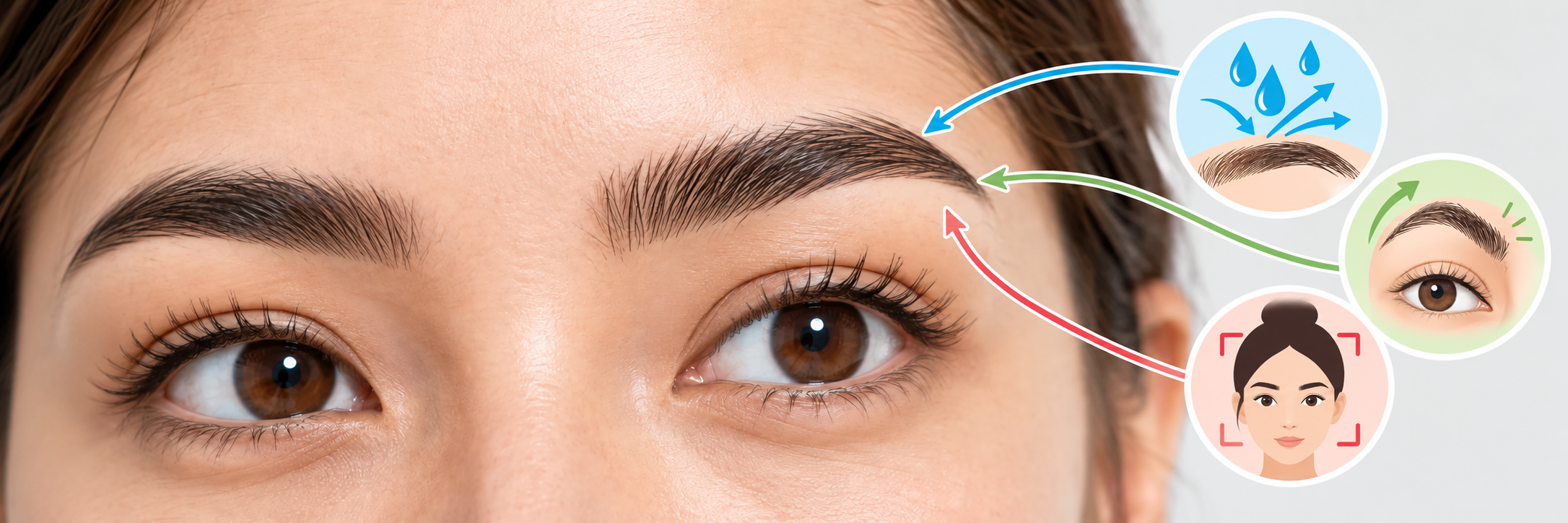
Why do we have eyebrows? These short strips of hair help shield the eyes, make faces easier to recognize and add meaning to facial expressions. Their shape can divert sweat and small particles, while the muscles around them let the brows rise, lower and draw together.
Why do we have eyebrows?
Eyebrows have several overlapping jobs. They form a light barrier above the eyes, move with the forehead and eye muscles during facial expressions, and provide a stable feature that helps distinguish one face from another. A clinical review of eyebrow and eyelash anatomy describes both their protective and expressive roles.
So, why do we need eyebrows when eyelids, eyelashes and tears also protect the eyes? Those systems work together. Eyebrows provide the first line of deflection above the eye, while eyelashes, blinking and tears handle material that gets closer to the eye’s surface.
What is the purpose of eyebrows?
What do eyebrows do for your eyes? The brow’s curved shape and the direction of its hairs help catch or redirect sweat, rain and small particles before they reach the eyes. This is useful because salty sweat can sting and briefly blur vision. Eyebrows may also reduce some overhead light, although they do not replace the protection provided by eyelids, eyelashes or sunglasses.
If you have wondered what are eyebrows for, protection is the most obvious physical answer. They are not a sealed shield, and moisture can still run past them, but their position above the orbital rim gives water and debris another obstacle before reaching the eye.
The function of eyebrows in facial expressions
Eyebrows move because several muscles act on the skin around them. The frontalis raises the brows, the corrugator supercilii pulls them inward and downward, and parts of the orbicularis oculi can lower them. A review of eyebrow positioning and muscle anatomy explains how this coordinated movement produces visible nonverbal cues.
A raised brow can accompany surprise or a question, while lowered or drawn-together brows may signal concentration, concern or anger. Context still matters; one eyebrow position cannot prove what someone feels. Even so, moving brows make spoken and silent communication easier to interpret.
Why are eyebrows important for facial recognition?
Eyebrows also help define identity. In a well-known experiment, participants had much more difficulty recognizing familiar faces after the eyebrows were digitally removed. The disruption was greater than when the eyes were removed, leading the researchers to conclude that eyebrows can be at least as influential as the eyes for recognition. The study is reported in The Role of Eyebrows in Face Recognition.
Their shape, thickness, spacing and contrast create a consistent visual pattern around the eyes. The brain combines that pattern with the nose, mouth, hairline and overall face rather than identifying a person from one feature alone. This reliance on familiarity connects with the way the brain evaluates a scene in what déjà vu is, although face recognition and déjà vu are different processes.
What is the evolutionary purpose of eyebrows?
Why do humans have eyebrows that can move so visibly? Protection from sweat and debris offers one plausible advantage, but communication may also have shaped human brows. Modern humans have relatively flat foreheads and mobile eyebrows compared with the large, rigid brow ridges of some earlier hominins. A study of brow-ridge evolution and social signalling proposed that a smoother forehead made subtle eyebrow movements more visible.
That idea is an evolutionary hypothesis, not proof that eyebrows arose for one single reason. Features can persist because they provide several advantages, and the protective, communicative and recognition roles of eyebrows are compatible rather than mutually exclusive.
Why eyebrow hair stays short
Eyebrow hairs follow the same basic growth cycle as other hairs, but their growing phase is much shorter than the growing phase of scalp hair. They therefore stop at a much shorter length before resting and shedding. A review of eyebrow hair biology explains that this shorter growth phase is a defining feature of eyebrow follicles.
The hairs also change direction across the brow. Those near the nose tend to point more upward, while hairs farther out lie more horizontally. This arrangement creates the familiar arch and supports the eyebrow’s moisture-deflecting function.
Why some people have sparse or missing eyebrows
Eyebrow thickness varies naturally with genetics, age and grooming. Repeated plucking or skin injury can damage follicles, while aging may make the brows thinner or change their color. Some people also have naturally light or fine eyebrow hair that is difficult to see.
Sudden, patchy or progressive eyebrow loss can have medical causes, including alopecia areata, thyroid disease, inflammatory skin conditions, infection or nutritional problems. A clinician can look for the underlying pattern, especially when hair loss is new, affects other areas or occurs with skin or general symptoms.
Frequently asked questions
Are eyebrows only cosmetic?
No. Brows strongly affect appearance, but they also help divert moisture and debris, add movement to facial expressions and provide cues used in face recognition.
Can people live without eyebrows?
Yes. Eyebrows are useful rather than essential for survival. A person without them may notice more sweat, glare or debris near the eyes, and the face may be harder for others to recognize at first.
Why do we have eyebrows if eyelashes protect the eyes?
They work at different positions. Eyebrows intercept some moisture and debris above the eye, while eyelashes help detect or block material at the eyelid margin. Blinking and tears provide additional protection.
Do shaved eyebrows grow back?
Usually, yes, because shaving cuts the hair above the skin without removing the follicle. Regrowth can take time because each follicle follows its own cycle. Scarring or a condition that damages the follicle can prevent normal regrowth.
The verdict
Why do we have eyebrows? They help keep sweat and particles away from the eyes, strengthen facial expressions and give the brain useful clues for recognizing faces. Their everyday value is easy to miss, much like the hidden mechanics behind why your stomach growls.
References
- Patel BC, et al. Eyebrow and Eyelash Alopecia: A Clinical Review. https://pmc.ncbi.nlm.nih.gov/articles/PMC9870835/
- Nguyen JV. The Biology, Structure, and Function of Eyebrow Hair. https://pubmed.ncbi.nlm.nih.gov/24385126/
- Sadr J, Jarudi I, Sinha P. The Role of Eyebrows in Face Recognition. https://pubmed.ncbi.nlm.nih.gov/12729380/
- Cotofana S, et al. The Anatomy behind Eyebrow Positioning. https://pubmed.ncbi.nlm.nih.gov/35139063/
- Godinho RM, Spikins P, O’Higgins P. Supraorbital Morphology and Social Dynamics in Human Evolution. https://www.nature.com/articles/s41559-018-0528-0