Does Honey Expire or Just Change With Age?
Honey has a reputation for lasting forever, yet the jar still comes with a best-before date. Leave it in the cupboard long enough and it may darken or become too grainy to pour. So does honey expire, or is it simply showing its age?
Does honey expire?
In the food-safety sense, no. Honey doesn’t support the growth of harmful bacteria, so it doesn’t spoil the way milk or cooked rice does.
A honey expiration date is often a best-before date: a guide to expected quality. According to the USDA, a “Best if Used By” date marks peak flavor and freshness, not safety — and except for infant formula, federal law doesn’t require food products to carry any date. Honey makers often print a two‑year mark simply because consumers expect a number, not because the honey changes at 24 months.
Properly stored honey can remain stable for decades, even centuries. Over time, however, it may darken, lose aroma, change flavor, or crystallize into a grainy solid, especially when exposed to heat. These are normal changes in quality and texture, not signs that the honey has suddenly become unsafe. So can honey go bad? Not in terms of safety — the sugars don’t spoil, only the flavor and quality gradually fade.
Why honey is so difficult to spoil
A 2024 Food Standards Agency review highlights several natural properties that contribute to the unusually long shelf life of honey.
It has very little available water. Honey is about 80–85% sugar and 17% water, but much of that water is bound by the sugars, leaving very little available for microbes to use. The high sugar concentration can also draw water out of microbial cells through osmosis, making it even harder for them to grow.
It is acidic. Honey’s pH ranges from 3.2 to 4.5, similar to orange juice, and this level of acidity makes it difficult for many bacteria to grow.
It makes its own peroxide. Bees add an enzyme called glucose oxidase, which helps form hydrogen peroxide when honey is diluted. Hydrogen peroxide is a strong antimicrobial compound, and this effect is one reason medical-grade honey is used in some wound dressings.
Honey is not sterile, though. Some dormant bacterial spores can survive without multiplying. This is especially important for babies, whose intestines can allow certain spores to become active.
Why does honey crystallize?
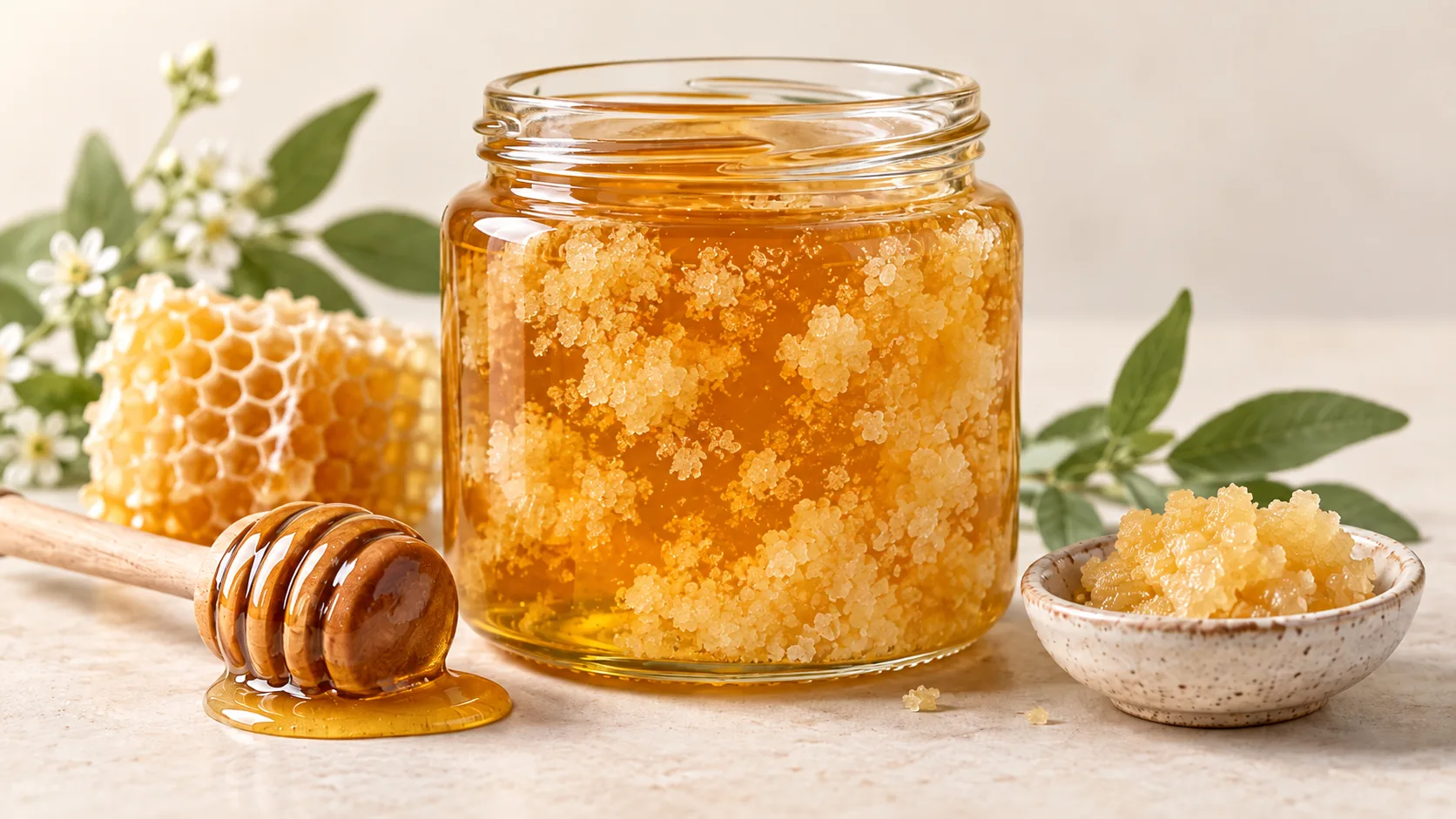
Honey contains so much dissolved sugar that some glucose can separate into solid crystals over time. This process, called crystallization, can make honey cloudy, grainy, or firm, but it does not mean the honey has spoiled.
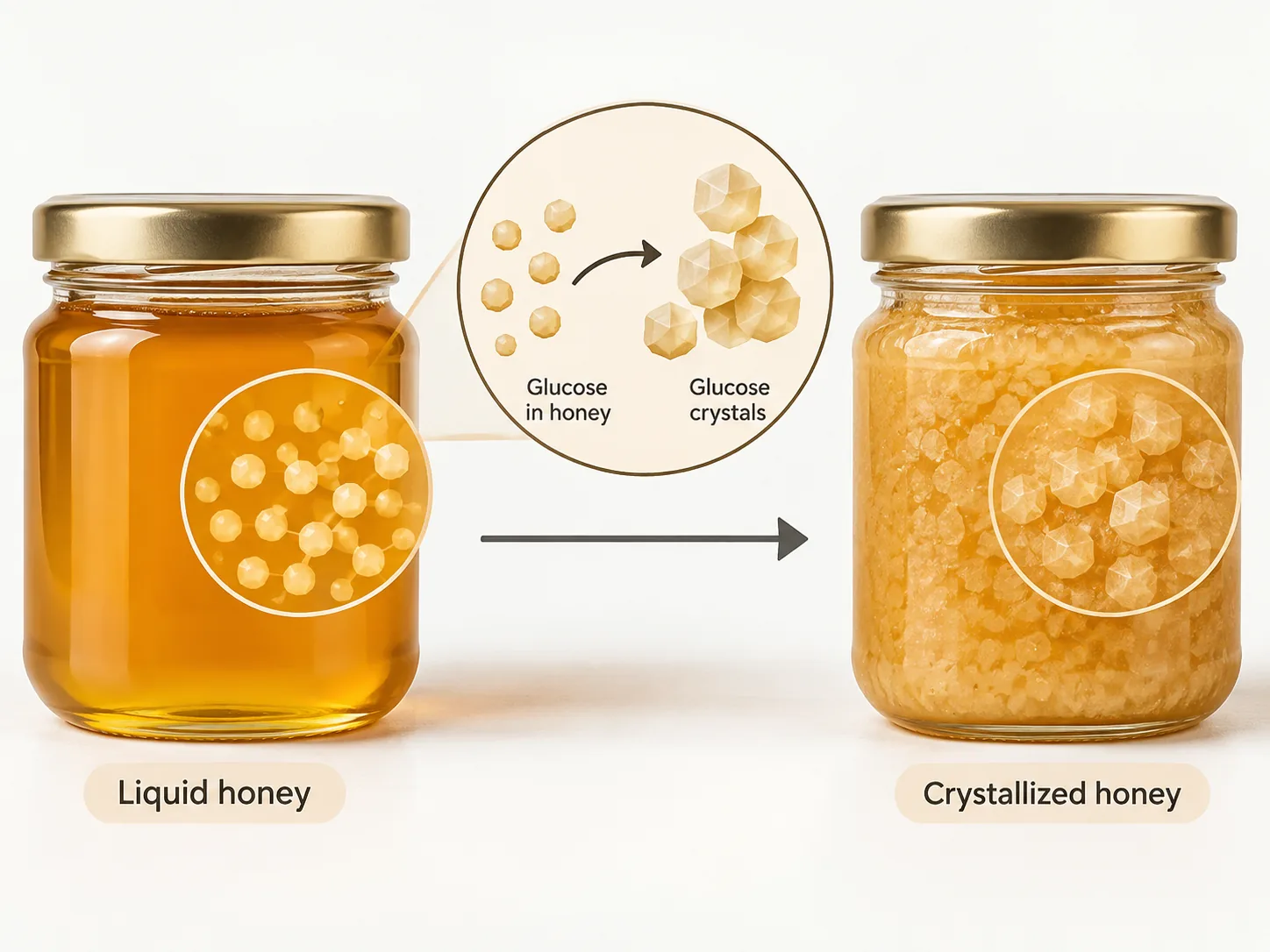
How quickly honey crystallizes depends on its sugar composition, storage temperature, and tiny particles such as pollen that help crystals form. Some types crystallize quickly, while others stay liquid much longer, so a firm jar is not necessarily older or lower quality.
Crystallized honey is safe to eat as long as it has been stored properly and shows no signs of spoilage. In fact, creamed honey is made by carefully controlling crystallization to create a smooth, spreadable texture.
If your honey has turned firm or grainy, you can return it to a more liquid texture. To decrystallize honey, place the container in warm water and stir gently with a clean, dry spoon until the crystals dissolve. Avoid getting water into the jar, as extra moisture can reduce its shelf life.
So, does honey go bad?
Yes, but usually only when the conditions that preserve it are disrupted.
Moisture is the main problem. Honey can absorb water from humid air, especially if the lid is loose. Although a little dilution can trigger hydrogen peroxide production, too much moisture increases the water available to microbes and can allow certain yeasts to grow.
If yeasts begin fermenting honey, they produce alcohol and carbon dioxide, leading to bubbling, foam, and an alcoholic or sour smell. A few air bubbles from pouring are harmless, but ongoing gas production together with an unusual odor may indicate spoilage.
Still, appearance alone cannot tell you whether honey has gone bad. These changes can help you tell the difference:
| Change in the jar | What it means |
| Cloudiness, grains, or a firm texture | Crystallized honey, not evidence of spoilage by itself. |
| Gradual darkening | Can reflect aging or heat exposure, color alone is not a spoilage test. |
| Persistent bubbling or foam with a new alcoholic or sour smell | Possible fermentation. Discard the honey rather than trying to rescue it by heating. |
| Visible mold or obvious contamination | Discard it. Do not taste it to decide whether it is safe. |
How honey changes over time
If honey is kept sealed and free from moisture, it won’t ferment — but that doesn’t mean it stays the same forever. Over time, heat and aging slowly break down its sugars and increase levels of hydroxymethylfurfural (HMF), a compound used as a marker of honey freshness and heat exposure.
A 2024 study of honeys stored from 1959 to 2020 found that HMF generally increased with age. Older honey may also become darker and lose some of its original flavor and aroma.
So while properly stored honey can remain safe for a very long time, its quality still declines with age. “Lasts indefinitely” does not mean “stays fresh indefinitely.”
How to store honey
Pure honey keeps best in a tightly sealed jar stored in a cool, dry cupboard away from heat and direct sunlight. It does not need to be refrigerated, and colder temperatures can make it crystallize faster. If the honey crystallizes, gently warm the container instead of adding water.
Use a clean, dry spoon when scooping honey to avoid introducing moisture into the jar. Once honey is mixed with tea, dressings, or other moist foods, it should be stored according to the finished mixture rather than treated like pure honey.
Why can’t babies have honey?
Babies under 12 months should not eat honey because it can contain dormant spores of Clostridium botulinum. In an infant’s still-developing gut, these spores can germinate, grow, and produce the toxin that causes infant botulism. This is why honey is unsafe for newborns and young infants even when the honey itself is fresh and shows no signs of spoilage.
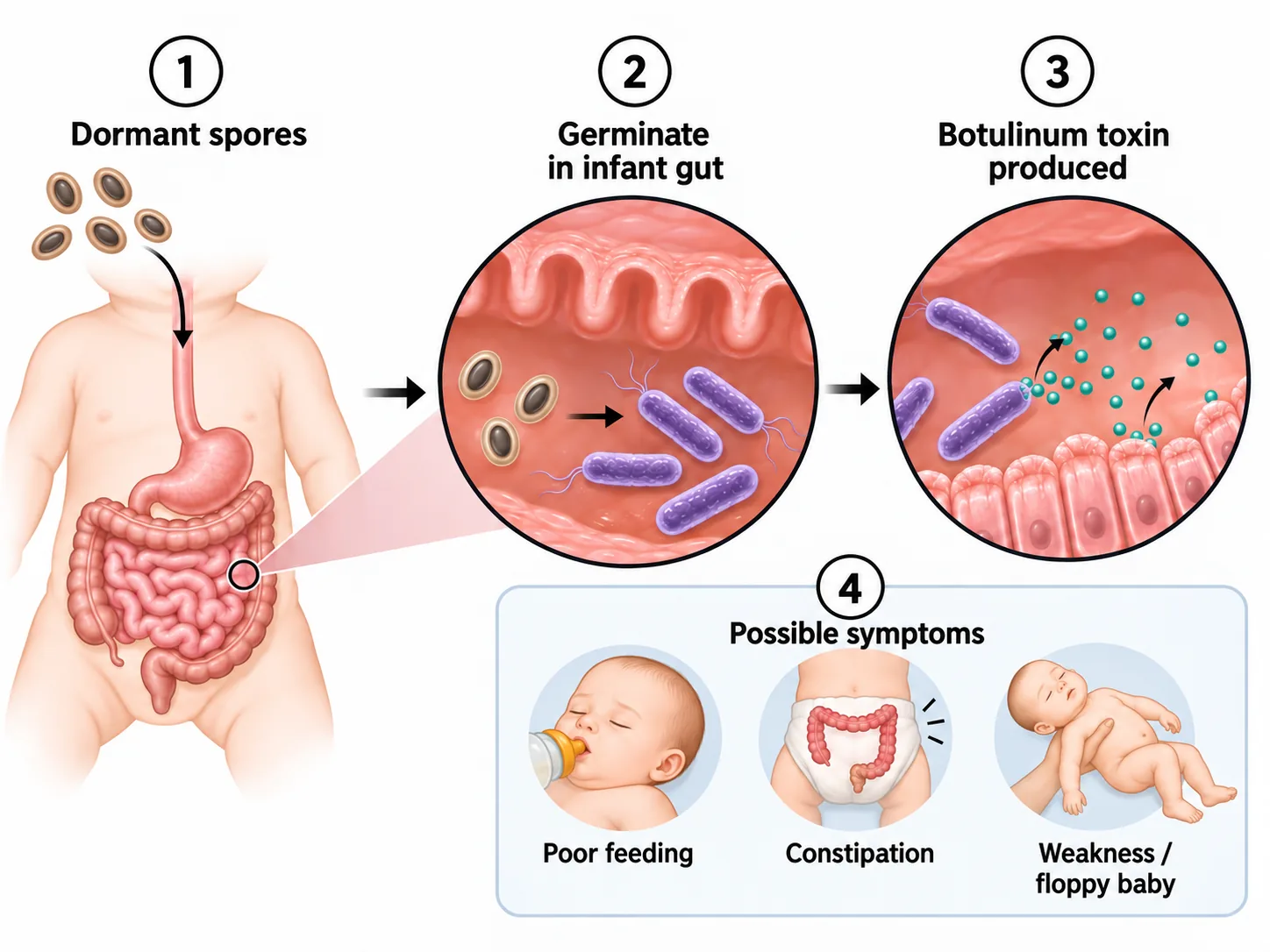
So, when can babies have honey? The CDC recommends waiting until after 12 months of age. Before then, honey should not be added to food, water, or formula or placed on a pacifier. The advice applies to both raw and pasteurized honey because routine pasteurization does not reliably destroy bacterial spores.
This applies to both raw and pasteurized honey because bacterial spores can survive conditions that kill active bacteria, much like the Bacillus cereus spores discussed in our fried rice syndrome article.
Frequently asked questions
How long does honey last?
Properly stored honey can last for years. Darkening, flavor loss, and crystallization are usually quality changes, not spoilage.
Is it safe to eat honey past the expiration date?
Usually, yes, if it looks and smells like honey. Check for a fermented smell, foam or mould. Honey crystals, darkening and a duller flavour are all normal and harmless.
Can honey grow mold?
Pure honey rarely grows mold, but if water gets into the jar, yeasts or molds can develop. Visible mold means the honey should be discarded.
What are honey crystals?
Honey crystals form when some of the glucose in honey hardens into solid crystals. This natural process can make honey grainy or firm, but crystallization doesn’t mean it has spoiled.
How to keep honey from crystallizing?
Store honey tightly sealed at room temperature. This can slow crystallization, but some varieties naturally crystallize faster than others, and crystals may return after warming.
How to soften honey without ruining it?
To decrystallize honey, place the container in warm water and stir gently with a clean, dry spoon. Keep water out of the jar and avoid excessive heat.
When can babies have honey?
Babies should wait until after 12 months to eat honey. Before then, spores in honey can cause infant botulism, but once the gut is mature, honey is safe.
The verdict
So, does honey expire? Not in any way that matters for safety. Its low water content, acidity, and bee-made peroxide leave nothing for pathogens to work with, allowing a sealed jar to remain edible for an extremely long time.
What honey does do is age. It may darken, lose some of its aroma, accumulate HMF, and crystallize. These changes affect texture, flavor, and freshness more than safety.
The practical rules are simple: keep moisture out of the jar, store honey properly, and never give it to babies under 12 months.
References
- USDA Food Safety and Inspection Service. Food Product Dating. https://www.fsis.usda.gov/food-safety/safe-food-handling-and-preparation/food-safety-basics/food-product-dating
- National Honey Board. Frequently Asked Questions — honey shelf life, storage and crystallization. https://honey.com/faq
- Hudson A, et al. Honey Risk Profile. Food Standards Agency and Food Standards Scotland, Research and Evidence. 2024. https://science.food.gov.uk/article/121411-honey-risk-profile
- Food and Agriculture Organization of the United Nations. Value-added products from beekeeping. Chapter 2: Honey. https://www.fao.org/4/w0076e/w0076e04.htm
- Utah State University Extension. Storing Sugars. https://extension.usu.edu/preserve-the-harvest/research/storing-sugars
- Ogwu MC, Izah SC. Honey as a natural antimicrobial. Antibiotics. 2025;14(3):255. doi:10.3390/antibiotics14030255. https://doi.org/10.3390/antibiotics14030255
- Ananias KR, Machado de Melo AA, de Moura CJ. Analysis of moisture content, acidity and contamination by yeast and molds in Apis mellifera L. honey from central Brazil. Brazilian Journal of Microbiology. 2013;44(3):679–683. doi:10.1590/S1517-83822013000300003. https://doi.org/10.1590/S1517-83822013000300003
- Sajtos Z, Ragyák ÁZ, Hódi F, Szigeti V, Bellér G, Baranyai E. Hydroxymethylfurfural content of old honey samples — does the sticky treat really last forever? LWT. 2024;193:115781. doi:10.1016/j.lwt.2024.115781. https://doi.org/10.1016/j.lwt.2024.115781
- World Health Organization. Botulism. 2023. https://www.who.int/news-room/fact-sheets/detail/botulism
- Centers for Disease Control and Prevention. Foods and Drinks to Avoid or Limit (Infant and Toddler Nutrition). https://www.cdc.gov/infant-toddler-nutrition/foods-and-drinks/foods-and-drinks-to-avoid-or-limit.html
- Munir MT, Mtimet N, Guillier L, et al. Physical treatments to control Clostridium botulinum hazards in food. Foods. 2023;12(8):1580. doi:10.3390/foods12081580. https://doi.org/10.3390/foods12081580