How Coffee May Shape the Gut Microbiome
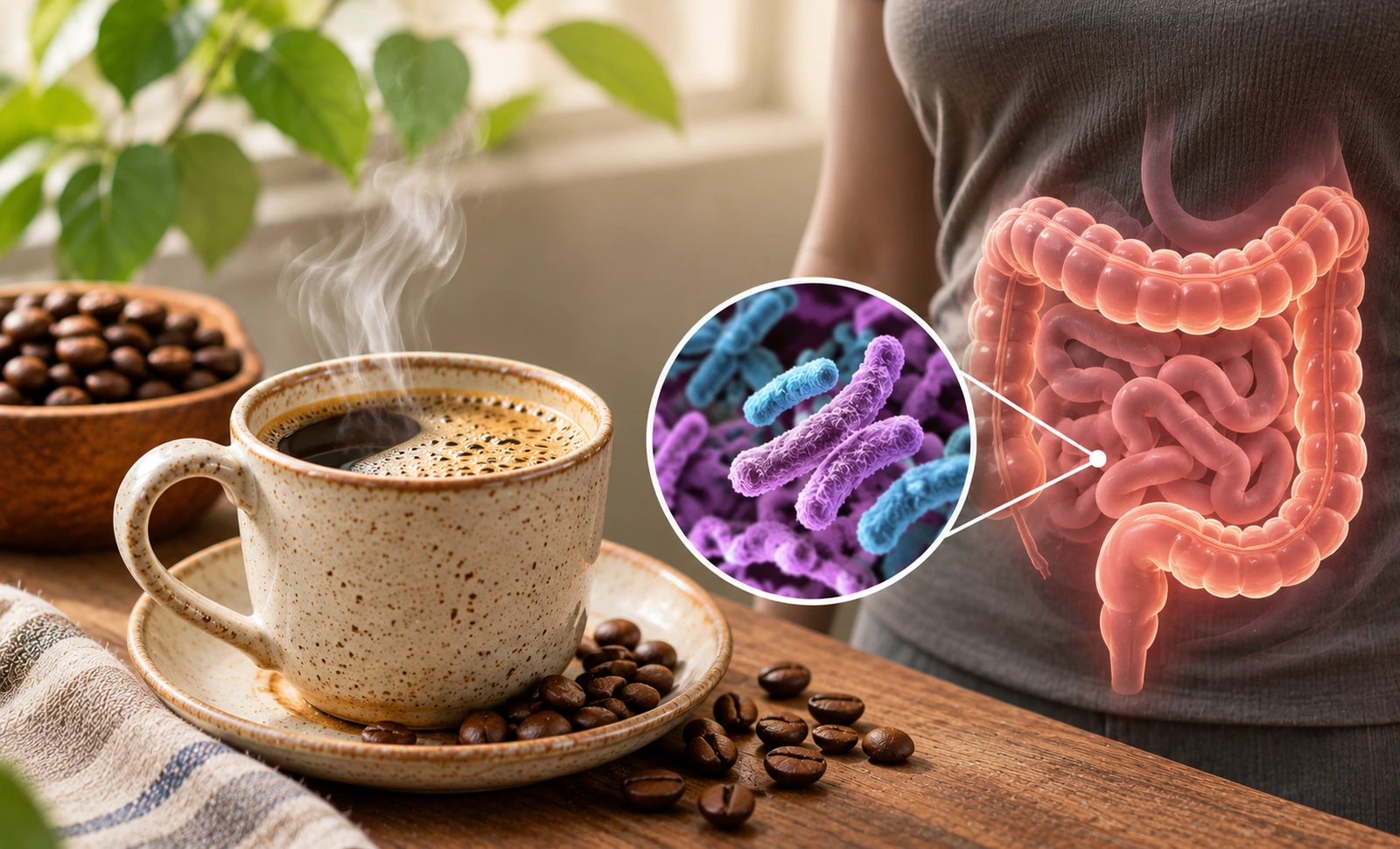
One clue that someone drinks coffee regularly can turn up in their stool. In a large study of coffee and the gut microbiome, a bacterium called Lawsonibacter asaccharolyticus made up a larger share of gut microbes in regular coffee drinkers. The link showed up among people who drank decaf, too. Some of the compounds in a cup reach the colon, where bacteria can break them down.
What researchers found in coffee drinkers
In the 2024 study, researchers analyzed bacterial DNA in stool samples from 22,867 people in the US and UK and compared the results with how much coffee those people usually drank. The strongest link was with Lawsonibacter asaccharolyticus, a bacterium that was already common among people who drank little coffee. Across nine US regions, it turned up in about 88% of people who rarely or never drank coffee and 98% of those in the highest intake group.
The gap was larger when the researchers looked at how much of the gut community the bacterium made up. In some groups, its median share was 4.5 to 8 times as high among people who drank the most coffee as among those who rarely drank it. Coffee drinkers may also differ in what they eat or how they live, so either could help explain part of the gap.
Does decaf coffee have the same effect?
To test whether coffee could affect the bacterium on its own, the researchers added regular and decaf coffee to lab cultures. The bacterium grew better with either kind under several of the conditions they tested. That fits with the link they found in decaf drinkers, which held even after the team accounted for how much regular coffee those people drank.
In a separate 2026 study, researchers looked at how the wider gut community responded when coffee drinkers stopped and then started again. After two weeks off coffee, 31 participants were randomly assigned regular coffee or decaf for three weeks. The share of some bacteria shifted in both groups, while the overall variety of microbes in each person’s samples stayed about the same. Since everyone went back to drinking coffee, the study leaves open what might have changed over those weeks if they’d stayed off it.
What reaches your colon after a cup?
Among the compounds in coffee that can reach the colon are chlorogenic acids, a group of plant compounds known as polyphenols. After a serving of instant coffee, researchers recovered about 70% of these compounds at the end of the small intestine, either intact or as breakdown products. They could measure this because the volunteers had an ileostomy, an opening that lets researchers collect what would normally pass into the colon.
In the colon, those compounds become part of what gut bacteria have available to break down, along with food residues that give rise to some of the molecules that make stool smell. When scientists mixed espresso with samples of gut bacteria, the acids broke down at different rates depending on whose bacteria were in the sample. That suggests the same coffee could leave a different mix of breakdown products from one person to the next. Which coffee compounds help L. asaccharolyticus grow is still unclear.
Is coffee good for your gut?
L. asaccharolyticus can make butyrate, a short-chain fatty acid that cells lining the colon use for energy. How much butyrate the bacterium makes depends on what it has available to break down and how active it is. So even if it makes up a larger share of the gut community, researchers still need to measure whether more butyrate reaches the cells that use it.
In a smaller study, a different group of bacteria called Bifidobacterium became more abundant in stool after 16 adults drank a particular instant coffee for three weeks. Because everyone drank the same coffee, the researchers couldn’t separate the effect of the drink from anything else that changed during that time.
Frequently asked questions
Is coffee a probiotic?
A probiotic supplies live microbes in an amount shown to benefit health. The coffee studies look at compounds that bacteria already living in the gut can break down. To call those compounds prebiotics, researchers would need to show that the way bacteria use them benefits the person drinking the coffee.
Why coffee can make you need the bathroom?
In one small study, regular and decaf coffee both increased muscle activity in the lower colon within four minutes in people who usually felt the urge to go after a cup. Those contractions can move stool that’s already in the colon toward the rectum, which helps explain why the urge can come on so quickly.
The verdict
Research on coffee and the gut microbiome has yet to establish what kind of coffee or how much to drink for better gut health. To answer that, researchers need to connect the changes in bacteria seen in stool samples with results people can notice, such as fewer digestive symptoms.
References
- U.S. Food and Drug Administration. Spilling the Beans: How Much Caffeine Is Too Much? https://www.fda.gov/consumers/consumer-updates/spilling-beans-how-much-caffeine-too-much
- Manghi et al. Coffee consumption and Lawsonibacter abundance. Nature Microbiology (2024). https://www.nature.com/articles/s41564-024-01858-9
- Boscaini et al. Habitual coffee intake, the gut microbiome, and host physiology. Nature Communications (2026). https://www.nature.com/articles/s41467-026-71264-8
- Stalmach et al. Coffee chlorogenic acid bioavailability in people with an ileostomy. Archives of Biochemistry and Biophysics (2010). https://pubmed.ncbi.nlm.nih.gov/20226754/
- Ludwig et al. Catabolism of coffee chlorogenic acids by human colonic microbiota. BioFactors (2013). https://pubmed.ncbi.nlm.nih.gov/23904092/
- Sakamoto et al. Identification of Lawsonibacter asaccharolyticus. International Journal of Systematic and Evolutionary Microbiology (2018). https://pubmed.ncbi.nlm.nih.gov/29745868/
- Roediger. Role of anaerobic bacteria in the metabolic welfare of the colonic mucosa in man. Gut (1980). https://gut.bmj.com/content/21/9/793
- Jaquet et al. Impact of coffee consumption on the gut microbiota: A human volunteer study. International Journal of Food Microbiology (2009). https://pubmed.ncbi.nlm.nih.gov/19217682/
- Hill et al. ISAPP consensus definition of a probiotic. Nature Reviews Gastroenterology & Hepatology (2014). https://pubmed.ncbi.nlm.nih.gov/24912386/
- Gibson et al. ISAPP consensus definition of a prebiotic. Nature Reviews Gastroenterology & Hepatology (2017). https://pubmed.ncbi.nlm.nih.gov/28611480/
- Brown et al. Effect of coffee on distal colon function. Gut (1990). https://pubmed.ncbi.nlm.nih.gov/2338272/