Baking Powder Past Its Prime: When It Stops Working
You find a can of baking powder behind the flour, and its date has passed. Does baking powder go bad? Usually the concern is whether it can still raise a cake or batch of biscuits. A dry, uncontaminated powder may work past its printed date; one that has absorbed moisture can lose its lift much sooner.
What happens when baking powder gets old?
Baking powder combines baking soda with powdered acids. When the ingredients become wet, they react to release carbon dioxide. Those gas bubbles expand in batter and help it rise. Most supermarket baking powders are double-acting: part of the reaction starts when liquid is added, and another part occurs as the batter heats, as NC State University explains.
Moisture getting into the can can start that chemistry before you bake. The gas escapes into the air, leaving less leavening power for the recipe. The result may be a flatter, denser muffin or biscuit. A powder can look ordinary and still be weak, which is why a performance test is more useful than appearance alone.
How long does baking powder last?
Does baking powder expire when the best-by date passes? Not necessarily. For an unopened can, the date is a quality guide, not a hard cutoff. Utah State University Extension says baking powder commonly carries a best-if-used-by period of 18 to 24 months and can remain functional longer if it stays sealed, dry, and uncontaminated. Storage conditions matter more than the calendar alone.
After opening, Utah State gives approximately six months as a practical shelf-life estimate. That is a reason to check an older can, not a guarantee that every can fails on the same day. A tightly closed container in a dry cupboard may retain activity; a can kept near steam may lose it early.
How to tell if baking powder is still good
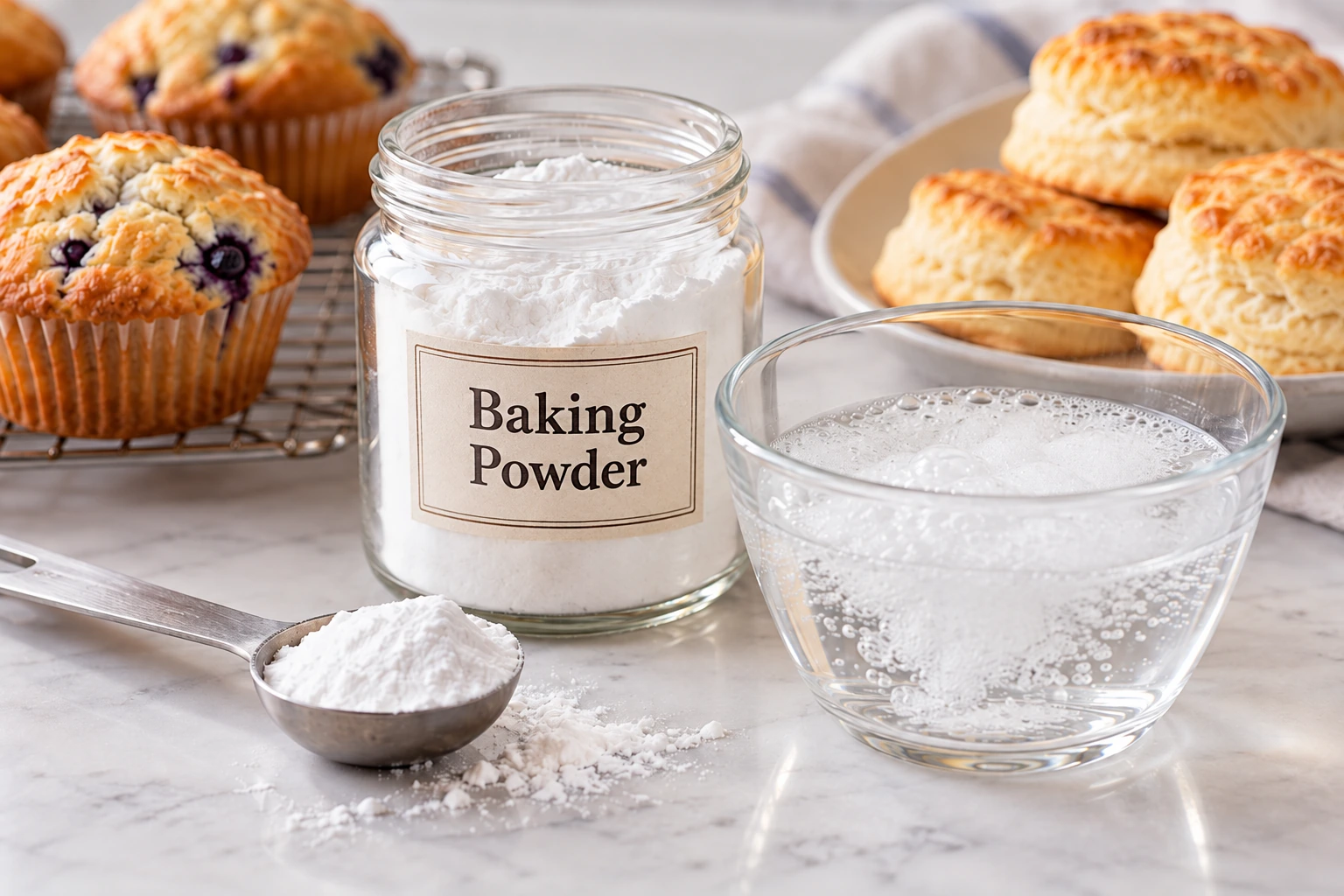
King Arthur Baking’s freshness test uses ½ teaspoon baking powder stirred into 2 tablespoons of warm water. The mixture should clearly bubble and foam. A few feeble bubbles, or none, suggest that the powder will not give reliable lift. Test a small sample in a separate bowl and discard it afterward.
The warm-water test checks the moisture-triggered part of the reaction. It does not measure the oven-triggered part separately, so it is a practical screening test rather than a precise promise about how high a cake will rise. If an important bake depends on it and the response is weak or doubtful, use a fresh can.
Check the container too. Hard clumps can signal that moisture has entered and some reaction may already have occurred. If the powder is visibly wet, moldy, discolored, or contaminated by pests or other food, discard it instead of testing or baking with it. Small loose lumps alone are not proof of failure; the fizz test helps settle that question.
Can you use expired baking powder?
Yes, when “expired” means only that the best-by date has passed and the powder has remained dry and clean. The U.S. Food and Drug Administration describes “Best if Used By” as a quality date. For baking powder, the meaningful question is whether enough gas-producing activity remains. If a sample foams well in warm water, it is generally reasonable to use; if it barely reacts, replace it.
Using weak baking powder is chiefly a recipe problem: the batter may not rise as intended. A date alone does not tell you whether the contents were kept free of moisture or contamination. Do not use a can with signs of either.
Keep moisture out of the can
Close the original container firmly and keep it in a dry cupboard away from the stove, sink, and dishwasher steam. Scoop with a dry measuring spoon, and write the opening date on the lid if you bake infrequently. Utah State recommends the original sealed can and identifies moisture as the main threat to leavening activity.
If your baking powder fails the test, a fresh can is the most predictable fix. Baking soda cannot replace baking powder spoon for spoon: it needs the right acid in the recipe and has different strength. King Arthur Baking’s substitution guide gives measured alternatives for a pinch, but swapping blindly can change both flavor and rise.
The verdict
So, does baking powder go bad? It can lose its lift before the date if it gets damp, but dry powder may still work after the date passes. For an opened can, six months is a useful time to check it. Stir a little into warm water before baking: clear bubbling means activity remains; a weak response means it is time for a new can.
References
- Utah State University Extension. Cooking Food Storage. https://extension.usu.edu/preserve-the-harvest/research/cooking-food-storage
- Hamel PJ. How to test yeast, baking powder, and baking soda for freshness. King Arthur Baking. 2015. https://www.kingarthurbaking.com/blog/2015/11/05/test-yeast-baking-powder-baking-soda-freshness
- Shipman M. The Difference Between Baking Soda and Baking Powder. NC State University. Updated 2026. https://news.ncsu.edu/2014/05/baking-soda-powder/
- U.S. Food and Drug Administration. How to Cut Food Waste and Maintain Food Safety. https://www.fda.gov/food/consumers/how-cut-food-waste-and-maintain-food-safety
- King Arthur Baking. What’s the difference between baking soda and baking powder? 2021. https://www.kingarthurbaking.com/blog/2021/09/10/baking-soda-vs-baking-powder-substitutions