
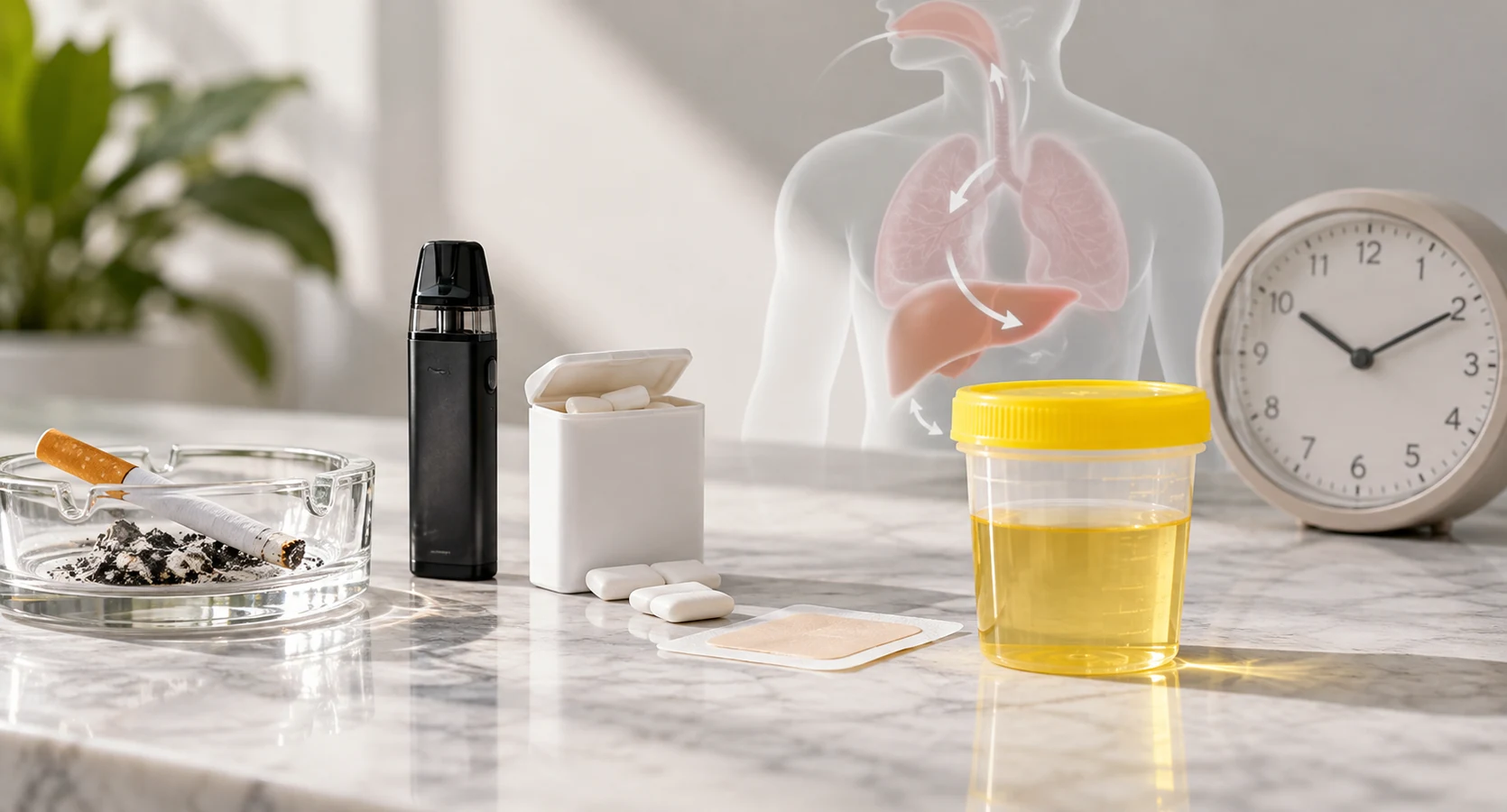
Nicotine in Your System: Detection Times and Metabolism
How long does nicotine stay in your system? Most nicotine clears within about a day after the last dose, but tests can detect its breakdown products for several days. Cravings may last longer still. These timelines differ because clearing a chemical, detecting past exposure, and adjusting to life without nicotine are separate processes.
That distinction matters whether nicotine comes from cigarettes, vaping, chewing tobacco, or a patch. To understand the numbers, it helps to follow what happens after nicotine enters the bloodstream.
From the bloodstream to the liver
Inhaled nicotine passes through the lungs into the blood and can reach the brain within seconds. Nicotine is a stimulant that promotes adrenaline release and activates reward pathways involving dopamine. These effects help explain why it can feel stimulating and become difficult to stop using.
The liver then breaks nicotine down, largely through an enzyme called CYP2A6. Much becomes cotinine, which is processed further before leaving the body, mainly through urine.
Dose also matters. How much nicotine is in a cigarette is different from how much reaches the blood. The same research review reports roughly 10–14 mg in a typical cigarette’s tobacco, with about 1–1.5 mg absorbed during smoking. Product design and smoking behavior affect the amount absorbed.
How long does nicotine stay in your system
The nicotine half-life is about two hours: blood levels fall by roughly half over that period once absorption is complete. Another two hours leaves about a quarter of the starting level. After roughly a day without further nicotine, most has been cleared, although this is not a guaranteed negative-test deadline.
Cotinine disappears more slowly. CDC laboratory documentation gives an estimated half-life of about 15–20 hours, compared with 0.5–3 hours for nicotine. That longer persistence makes cotinine more useful for identifying recent exposure.
Nicotine detection in urine and blood
Many “nicotine tests” measure cotinine rather than nicotine itself. A research report in Nicotine & Tobacco Research estimates about 80–100 hours, roughly three to four days, to fall below commonly used nonsmoking thresholds under average conditions. It recommends allowing six to seven days when assessing abstinence because some people clear cotinine more slowly. These are estimates, not universal detection limits.
| Sample | What the result means |
| Blood | Cotinine can show recent exposure for several days after nicotine itself has largely cleared. |
| Urine | Cotinine is more concentrated, making urine sensitive to lower exposure levels; results depend on the cutoff. |
| Saliva | Cotinine generally tracks blood levels, so it also reflects exposure over several days. |
So, how long does nicotine stay in urine or blood? First check which substance the test measures. A positive cotinine result shows exposure; it does not mean nicotine’s immediate effects are still present.
The answer also depends on the starting level, frequency of use, and individual metabolism. In a study of 139 twin pairs, researchers found a substantial genetic contribution to nicotine clearance. Two people who stop on the same day may therefore reach a test’s cutoff at different times.
How long does nicotine stay in your system after vaping
Once absorbed, nicotine follows the same metabolic pathways regardless of the product. Vaping does not give it a separate half-life. The amount absorbed and frequency of use affect how much nicotine and cotinine are present when use stops.
Nicotine gum, lozenges, and patches also produce cotinine, so a positive result cannot by itself prove smoking. These products have a different purpose: FDA-approved nicotine replacement therapy helps adults quit smoking by reducing withdrawal without exposure to cigarette smoke’s toxic mixture. Tell the testing clinician about any nicotine products being used.
Does nicotine show up in a drug test? Only if the testing panel includes nicotine or its markers. For example, standard US Department of Transportation drug testing does not include nicotine. A separate nicotine test is a different screen.
Why withdrawal lasts longer than nicotine
Nicotine withdrawal symptoms can continue after nicotine has largely cleared because the brain is adjusting to the absence of a drug it has adapted to. Common symptoms include cravings, irritability, difficulty concentrating, disturbed sleep, and increased appetite.
The National Cancer Institute’s nicotine withdrawal timeline places the worst symptoms in the first week, often peaking during the first three days. Symptoms generally ease over the first month, although some persist longer. Familiar situations, such as drinking coffee or being around smokers, can trigger cravings long afterward.
Cravings weeks after quitting do not mean nicotine is still circulating at the same level. They can reflect the brain’s adjustment and learned associations with smoking.
References
- Benowitz NL, Hukkanen J, Jacob P III. Nicotine chemistry, metabolism, kinetics and biomarkers. Handbook of Experimental Pharmacology. 2009;192:29–60. https://pmc.ncbi.nlm.nih.gov/articles/PMC2953858/
- Benowitz NL, et al. Biochemical verification of tobacco use and abstinence: 2019 update. Nicotine & Tobacco Research. 2020;22(7):1086–1097. https://doi.org/10.1093/ntr/ntz132
- Swan GE, et al. Nicotine metabolism: the impact of CYP2A6 on estimates of additive genetic influence. Pharmacogenetics and Genomics. 2005;15(2):115–125. https://pubmed.ncbi.nlm.nih.gov/15861035/
- CDC. NHANES 2017–2018 Cotinine and Hydroxycotinine—Serum. https://wwwn.cdc.gov/Nchs/Data/Nhanes/Public/2017/DataFiles/COT_J.htm
- National Institutes of Health. Tobacco. https://health.nih.gov/health-topics-a-z/tobacco
- FDA. Nicotine Is Why Tobacco Products Are Addictive. https://www.fda.gov/tobacco-products/health-effects-tobacco-use/nicotine-why-tobacco-products-are-addictive
- Federal Motor Carrier Safety Administration. What substances are tested? https://www.fmcsa.dot.gov/regulations/drug-alcohol-testing/which-substances-are-tested
- National Cancer Institute. Handling Nicotine Withdrawal and Triggers When You Decide To Quit Tobacco. https://www.cancer.gov/about-cancer/causes-prevention/risk/tobacco/withdrawal-fact-sheet