
Night Terrors in Adults: Why They Happen and What Helps
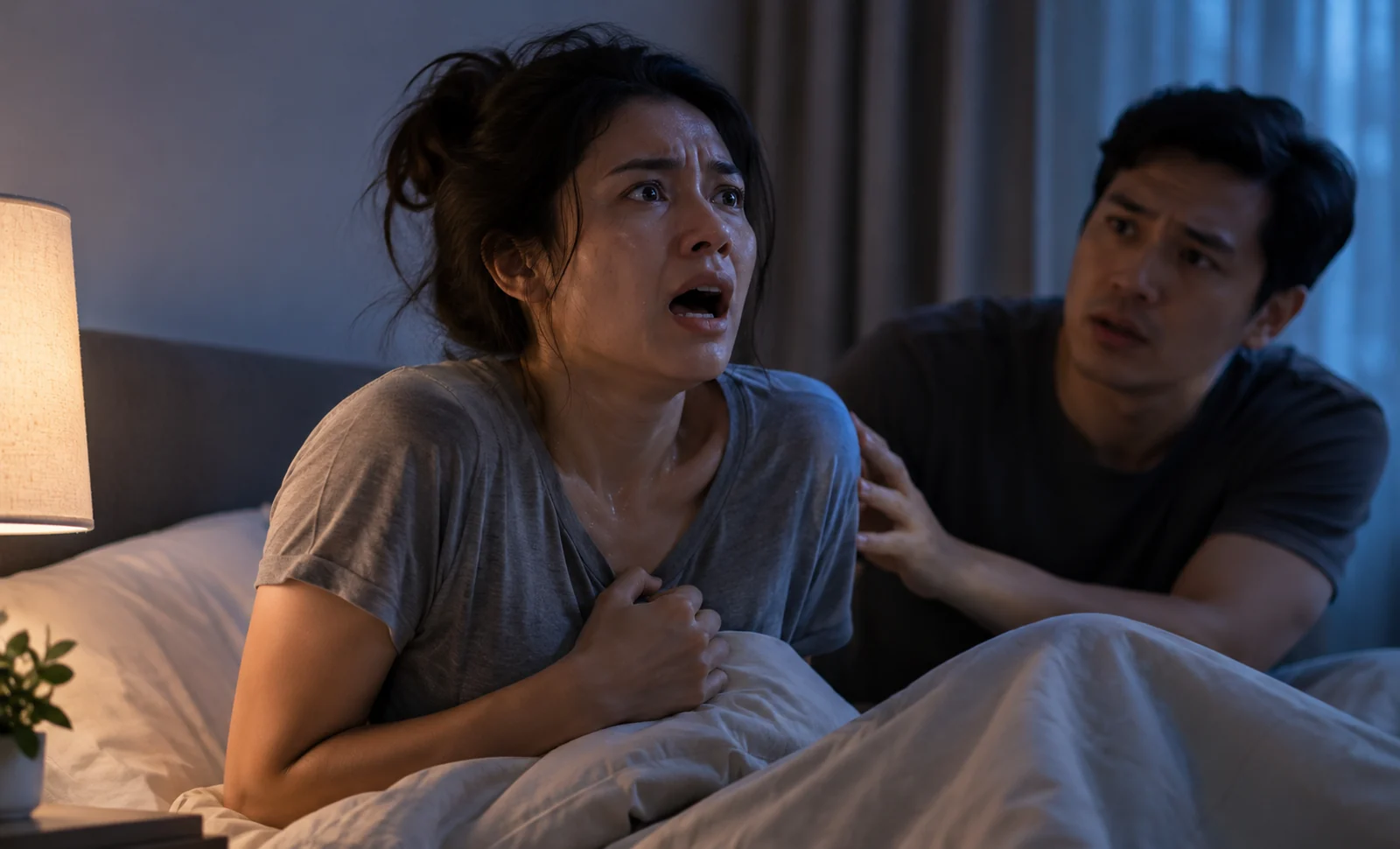
You hear a shout and turn to find your partner sitting up, wide-eyed and breathing hard. They barely respond when you ask what’s wrong. The next morning, you bring it up over breakfast and they have no idea what you’re talking about. That gap between how awake someone looks and how much they remember is one clue to recognizing night terrors in adults.
What are night terrors?
Night terrors, also called sleep terrors, are a type of parasomnia, an unusual behavior or experience during sleep. An episode usually starts when someone partly wakes from deep non-REM sleep. We spend more time in this stage of sleep early in the night, which is why night terrors often happen in the first few hours after falling asleep.
During that partial awakening, a scream may be the first thing you notice. Other symptoms of night terrors include sweating, a racing heart, and rapid breathing. The person might even get out of bed, which is where night terrors can overlap with sleepwalking. Their eyes may be open while they seem confused or barely notice the person beside them.
Night terror vs nightmare
One way to tell the two apart is to notice what happens right afterward. Someone who’s had a nightmare usually wakes up and can describe what scared them, whether it’s a single image or a scene involving someone they know. Nightmares often occur during REM sleep, which makes up more of the later part of the night. During a night terror, someone may barely respond before settling back into sleep.
Memory alone can be less clear-cut. When researchers recorded episodes of non-REM parasomnias in adults and asked about them right afterward, some people described dreamlike experiences, while others had little or no recall. How fully someone wakes is another clue. People having nocturnal panic attacks, for instance, wake fully and remember the racing heart and fear, even if they’re unsure what set it off.
What causes night terrors in adults?
Night terrors can run in families, and some adults have had them since childhood. Whether an episode happens on a particular night can depend on how much sleep you’ve had and what interrupts it. Sleep deprivation, an irregular sleep schedule, stress, alcohol, and some medications can make episodes more likely.
Obstructive sleep apnea can also play a part. When breathing repeatedly pauses, the brief arousals that follow can disrupt deep sleep. Loud snoring, gasping for air, and feeling unusually sleepy during the day are sleep apnea symptoms worth mentioning to a doctor.
How to deal with night terrors in the moment
If someone beside you is having a night terror, stay calm and give them room to settle. Trying to shake them awake can leave them more confused or upset. If they get up and head toward stairs or another hazard, guide them away gently. Clearing the floor around the bed can make the room safer if episodes happen again.
How to stop night terrors from recurring
If episodes tend to follow late nights or an uneven schedule, getting enough sleep and keeping a consistent wake time may help. Cutting back on alcohol close to bedtime can also help if you’ve noticed a connection. A sleep diary makes it easier to spot patterns. Note when you went to bed, when the episodes happened, and what a partner noticed.
Treatment for night terrors can also involve treating the condition that’s interrupting sleep. In a review of records from 512 sleep-clinic patients, some people with non-REM parasomnias reported getting their episodes under control after treatment for a separate sleep disorder, such as sleep apnea. If the episodes began after you started a new medicine, tell your prescriber about the timing.
When to see a doctor
If episodes start in adulthood, keep happening, put someone at risk of injury, or leave you tired during the day, bring them up with a doctor. A bed partner’s description can help, especially if you remember little yourself. An overnight video sleep study may help sort out similar-looking episodes, including sleep-related seizures or REM sleep behavior disorder.
Frequently asked questions
How common are night terrors in adults?
In a telephone survey of 1,000 adults in Norway, about 3 in 100 said they’d had a sleep terror in the previous three months. That estimate relies on people reporting episodes they may only know about because someone else saw them.
How long do night terrors last?
A night terror usually passes in a few minutes, though some episodes go on longer.
References
- Mainieri et al. Diagnosis and management of NREM sleep parasomnias in children and adults. Diagnostics (2023). https://www.mdpi.com/2075-4418/13/7/1261
- National Heart, Lung, and Blood Institute. Sleep phases and stages. https://www.nhlbi.nih.gov/health/sleep/stages-of-sleep
- NHS. Night terrors and nightmares. https://www.nhs.uk/conditions/night-terrors/
- Cataldi et al. Shared EEG correlates between non-REM parasomnia experiences and dreams. Nature Communications (2024). https://pubmed.ncbi.nlm.nih.gov/38724511/
- Craske and Tsao. Assessment and treatment of nocturnal panic attacks. Sleep Medicine Reviews (2005). https://pubmed.ncbi.nlm.nih.gov/15893248/
- National Heart, Lung, and Blood Institute. Sleep apnea symptoms. https://www.nhlbi.nih.gov/health/sleep-apnea/symptoms
- Drakatos et al. NREM parasomnias: A treatment approach based upon a retrospective case series of 512 patients. Sleep Medicine (2019). https://pubmed.ncbi.nlm.nih.gov/29753639/
- Bjorvatn et al. Prevalence of different parasomnias in the general population. Sleep Medicine (2010). https://pubmed.ncbi.nlm.nih.gov/21093361/
- Bollu et al. Sleep medicine: Parasomnias. Missouri Medicine (2018). https://pmc.ncbi.nlm.nih.gov/articles/PMC6139852/